


2 July 2026
|
NEWS
KNCB HIGH PERFORMANCE
Building for Excellence: A Year in Review and the Road Ahead
Twelve months into this role, I find myself reflecting on a journey that has been both deeply rewarding and, at times, genuinely humbling. Dutch cricket is at an inflection point. The talent is here. The ambition is here. And — I am pleased to say — the progress is real. But so too are the structural challenges that, if left unaddressed, risk limiting what this programme can ultimately become.
What We Have Built This Year
When I joined the High Performance board, I made a commitment to understand the programme from the ground up — not to arrive with a predetermined playbook, but to listen, assess and then act. What I found was a group of dedicated coaches, support staff and athletes who were, in many cases, doing exceptional work with constrained resources. My role has been to advocate for them, challenge where necessary, and help build the environment in which Dutch cricket can genuinely compete.
On the men's side, the last twelve months have given us real cause for encouragement. The national team has continued to develop its identity as a competitive force at the Associate level, demonstrating that when the conditions are right — adequate preparation time, the right fixtures, and a settled squad — the Netherlands can test Full Member nations. The results have not always gone our way, but the performances have increasingly shown the depth of character and technical quality that the programme has been working to develop.
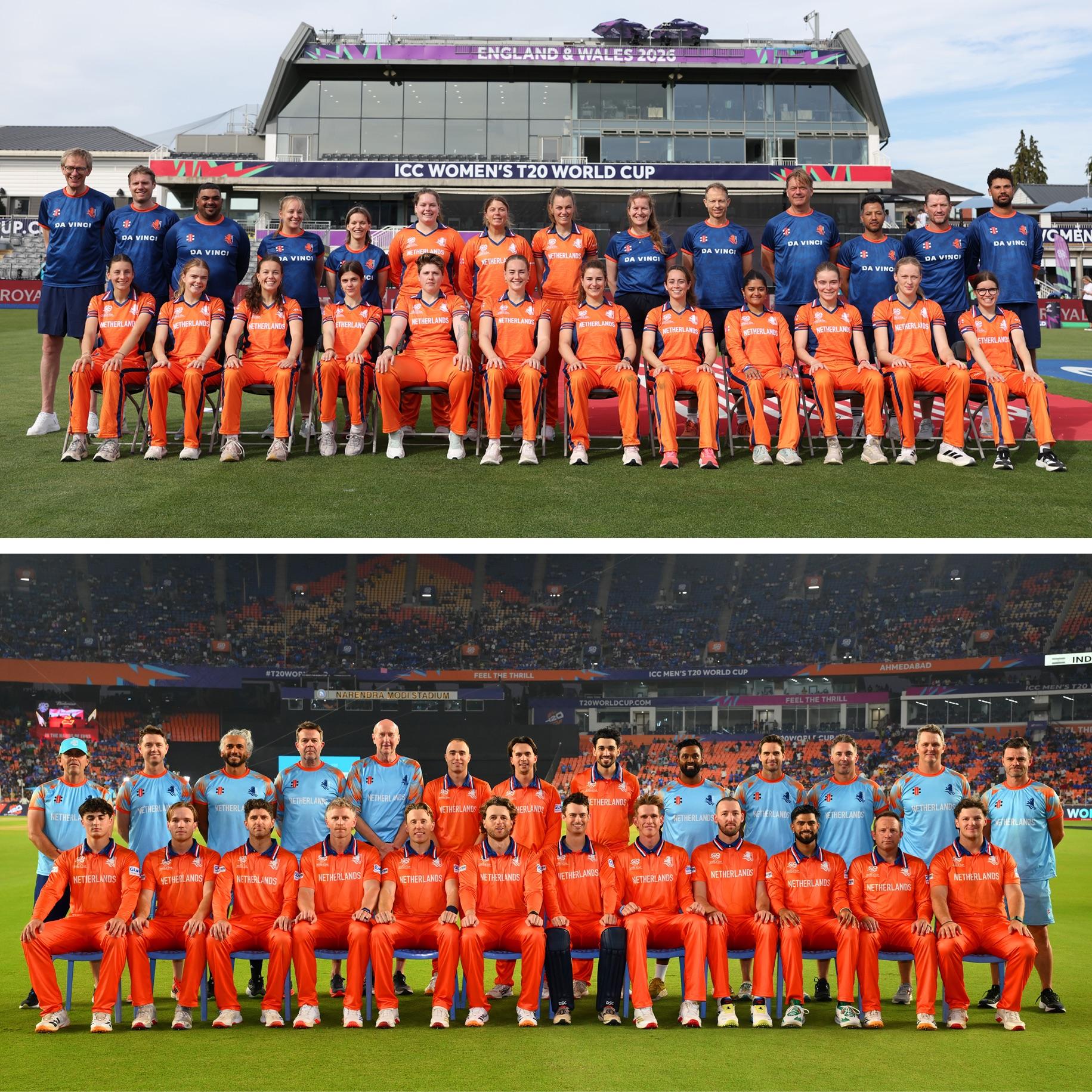
The women’s programme deserves particular recognition, and this year it reached a genuine milestone: for the first time in our history, the Netherlands qualified for the ICC Women’s T20 World Cup. To take our place among the best twelve teams in the world — in England, on the sport’s biggest stage — is an achievement that would have seemed remote not long ago. The growth this squad has shown over the past six months, in the build-up to the tournament, has been quite wonderful to witness: growth in squad depth, in coaching quality, in tactical maturity, and above all in the team’s belief in what they can achieve.
Drawn into a formidable group, our women came up against opponents of the very highest calibre, and the scorecards — defeats to Bangladesh, India and Australia in the group stage — do not, in black and white, tell the full story of what this team has become. What the numbers cannot capture is the manner in which the squad competed, the lessons absorbed against world-class opposition, and the distance travelled in a remarkably short space of time. What the tournament has given us, for the first time ever, is a clear and honest line in the sand: a true measure of where we stand against the best in the world, and a precise understanding of the gap we must now close. That clarity is itself a form of progress.
As the High Performance board member, I am proud — deeply proud — of the way this team has conducted itself throughout. They carried themselves with dignity, ambition and professionalism on the largest stage the women’s game has to offer. And beyond the cricket, seeing the sheer joy on the players’ faces — the pride of representing the Netherlands at a World Cup — is something I will carry with me for a long time. The women’s game globally is on an extraordinary trajectory, and our programme has now firmly placed itself within that story. There is an ambition and a professionalism within this squad that is genuinely exciting to observe, and the foundations laid this year give every reason for confidence in what comes next.
We have also taken important steps in how we think about talent identification and long-term development — work that underpins everything else we do.
The Academy: Investing in What Comes Next
Perhaps the most significant structural development of the past year has been the establishment of the KNCB Academy. This is not a peripheral initiative. This is foundational.
For too long, the pathway between domestic cricket and the national team has been insufficiently structured. Talented players have emerged, but the bridge between promise and international readiness has sometimes been left to chance. The Academy changes that. It creates a defined, high-quality environment in which the next generation of Dutch internationals can develop with purpose — with access to superior coaching, sports science, and the kind of competitive exposure that accelerates growth.
I want to be clear about why this matters from a board perspective: the Academy is not a cost centre. It is an investment with a generational return. Every euro invested in developing a player in their late teens and early twenties pays dividends for a decade or more. We must protect and grow this programme with the same seriousness with which any well-governed organisation treats its most important capital projects.
The Year Ahead: An Exciting but Demanding Calendar
Looking forward, the international calendar for both the men's and women's programmes presents opportunity alongside significant challenge.
For the men, the coming twelve months include a series of fixtures that offer the squad the kind of competitive exposure that is genuinely difficult to replicate in any other context. Qualification events and bilateral series will test the squad's depth and versatility in ways that we should welcome. These matches are not just scorecards — they are the classroom in which elite cricketers learn.
For the women, the World Cup is not an endpoint but a springboard. Having now tested ourselves against the best in the world, the priority must be to build on that experience rather than let it stand alone. The continued expansion of women’s international cricket globally means our programme will be tested more rigorously than ever before, and that is precisely what we need. We should be sending our women’s squad into those environments with every possible resource and preparation at their disposal, so that the line in the sand drawn this summer becomes a baseline we steadily move beyond.
The start of the Academy also means we will be integrating younger talent into a broader high-performance ecosystem for the first time. Managed carefully, this creates an energy and a competitive pressure within the programme that raises standards for everyone.
The Honest Conversation: Challenges We Must Address
I have never believed that high performance board members serve their sport well by speaking only in the language of optimism. Candour, delivered respectfully and constructively, is a responsibility.
So let me be direct about three challenges that, in my view, require urgent and sustained attention.
Player Contracts. The current position — in which a significant number of our international players are contracted for less than twelve months — is not consistent with building the stability and continuity that elite performance requires. Professional athletes plan their lives, their training blocks and their competitive commitments around the security of their contracts. When that security is absent or limited, the consequences are real: players make decisions about employment and availability that are entirely rational given their circumstances, but which are suboptimal for the programme. We need to move, as a governing body, towards longer-term contractual frameworks. This is not simply a welfare issue, though it is that too — it is a performance imperative.
Financial Resources. I will not pretend that this is a simple problem to solve, because it is not. The KNCB operates in a funding environment that reflects the broader realities of Associate cricket — where the distribution of resources within the global game remains deeply unequal. But that context, while important, cannot become an excuse for inaction. We must be more creative and more aggressive in identifying new revenue streams — through commercial partnerships, through engagement with the Dutch business community, through the diaspora communities that follow this sport passionately, and through the growing global appetite for cricket content and experiences. Mediocrity in resource generation leads, inevitably, to mediocrity in performance. That is not a future I am willing to accept.
The Volume of International Cricket. This is the challenge that I believe is most misunderstood by those outside the high-performance environment. The gap between Associate and Full Member cricket is not — as is sometimes supposed — primarily a gap in talent. It is, to a substantial degree, a gap in competitive exposure. Full Member players accumulate hundreds of days of international cricket across formats. They develop under sustained pressure, against the very best in the world, on a continuous basis. Our players do not have that luxury. And the cold, hard truth is that there is no substitute for that competitive experience. We can train perfectly. We can coach brilliantly. But until Dutch cricketers — men and women — are playing significantly more international cricket against elite opposition, the ceiling on this programme's development will remain artificially low. This requires advocacy at ICC level, creative fixture scheduling, and the KNCB using every relationship and every platform available to make the case for more equitable access to international competition.
A Note on Resource Allocation
I want to speak directly to the question of how the KNCB prioritises its resources, because I believe it is a conversation that the governing body must continue to have with clarity and courage.
High performance is not the only priority of this organisation, and it should not be. The grassroots of this game, the participation levels, the pathway for young players of all backgrounds — these all matter enormously. I am not arguing for high performance at the expense of everything else.
But I am arguing — firmly, and from experience — that investment in high performance is one of the most powerful levers available to a governing body that wants to grow its sport. When the national team performs well, people watch. When people watch, children pick up bats. When children pick up bats, clubs grow. The virtuous cycle flows from the top of the performance pyramid, and underinvesting in high performance is a false economy.
We must ensure that as we make difficult resource allocation decisions — and they will continue to be difficult — the strategic importance of high performance is given its proper weight.
In Closing
Twelve months in, I am proud of what has been achieved, clear-eyed about what remains to be done, and genuinely optimistic about where this programme can go. The Netherlands has everything it needs to be a force in world cricket — the talent, the infrastructure foundations, the passion, and increasingly, the professional culture.
But optimism alone is not a strategy. We must continue to make the hard arguments, pursue the new revenues, advocate for our players, and ensure that every decision taken at board level keeps the long-term health of Dutch high performance cricket front and centre.
The work continues. I look forward to reporting further progress in the months ahead.
Sybrand Engelbrecht